

Have you MET men?
On the subject of flattening humanity in making a point.

One of the occupational hazards of presenting an opinion on social media is that it will be challenged. Indeed, the comments section is often rife with those bad faith arguments and senseless trolling, but sometimes, there will be someone who simply disagrees and would like to give a counter-argument, or they may want to cordially refute a statement.
As a content creator (I still chuckle when I say this or type this title), I know that I am inviting an audience into my world of opinions and expect, even encourage, a civil debate from them if it comes down to that. Finding comfort in an echo chamber does not yield growth and perspective. If I am challenged and am tempted to shut down the discussion because it makes me uncomfortable, I try to ask myself a few things:
The monoliths we make out of each other is exactly why true connection seems harder and harder to achieve, especially when it comes to online communication. The algorithms, as they engineer us socially, perpetuate that.Why does this make me feel uncomfortable?
Should I explore the possibility of sitting through the discomfort and then push past it so I can respond or maybe even gain some perspective?
I don’t, and never will, feel it productive to flatten the humanity of others to prove a point, even if it might feel satisfying or helps me cope with the discomfort. I know we have our “lived experience,” but that does not give me carte blanche to wholesale denigrate human beings for immutable characteristics, no matter what structure we have assigned to these people based on those immutable characteristics.
Beliefs, theories, philosophies are just that. When they become orthodoxy, true progress fails, and we perpetuate, or even exacerbate, the very issues that we are trying to remedy. Likewise, reducing ourselves and others to our identities has its consequences as well. It’s another form of flattening, and often this simplifying does such a disservice to our argument. We are in fact multitudes within our personalities—we embody much more than our sexuality, gender identity, and so forth. Those spaces between our “intersectionality”—they contain who we really are, and this is what we often forget.
I encountered a reel on Instagram where an individual expressed their opinion on wearing fragrance and how it pertains to de-centering men. For those who aren’t aware of the concept of de-centering men, this concept surrounds organizing one’s life around approval, attention, or validation from men. While I think there could be more nuance to this, the overall premise is something I can’t argue with. Truthfully, the healthiest attitude a human could have is to avoid organizing one’s life around approval, attention or validation from anyone, full stop. I do take into consideration that I cannot fully understand the lens out of which a woman may view men and the kind of hyper-vigilance and suspicion women may have around the behavior of men. I want to be clear that I do not discount this. I can also consider that there are patriarchal cultures and societies where women must navigate through misogynistic attitudes and behavior, not to mention feeling unsafe around men who violate boundaries and make presumptions about a woman’s intentions. I honor and center this, always.
But none of this is that for which I take umbrage. Rather, it was the tone that felt unnerving from the perspective of a man and a man who is attracted to other males (I am notoriously avoidant of labels, but for the sake of clarity, I am bisexual/gay, take that as you will). It felt more as if it was in fact centering men in a way that was disparaging and distilled into an essentialism that leaves out the multitudes that just as much make up males as does females, especially that of gay/queer males who identify as men.
Here is a what is said on the reel:
“Getting a compliment from a man when I’m wearing perfume means that he’s too close to me because why would a man be there? The idea that I wear perfume or any woman necessarily wears perfume to get a man…have you MET men? Have you SEEN them? Why would I do that? Why would anyone do that? I’m just thinking about how we assume why other people wear fragrance. I noticed that a lot of men on fragrancetok, they talk about using fragrance to get girls. This is very much in the pipeline for look-maxxing incel culture stuff around like ‘if you do this and this like a calculation, then will women will want to have sex with you. None of that is true (chuckles). It’s the people that are perpetuating these kind of calculations, I would never want to be alone in a room with. They’re very much like, “where’s my hug” kind of people of men. No swag in person at all. Just need to say out loud to remind the world that there are plenty of people in the universe that do not center men in their choices, okay? Nothing about this fit has anything to do with the male gaze, I promise you. This is for the gays, the ‘theys’ and the girls…it’s never for a man. Never.”
Honestly, I really don’t take issue with much of this, besides the target of fragrancetok “bros” with their boorish behavior is already a widely known scourge in the fragrance community, and I agree that probably all of them would lack the ability to tastefully court a woman in the physical world. Hell, they’d probably be extremely awkward and have nearly none of the braggadocio. In other words, they are dorks, and not worth the attention. I do think that most of them a harmless, lonely young men who are products of an age that ends up sending them down the pipeline because of things said like this:
“Have you MET men? Have you SEEN them? Why would I do that? Why would anyone do that?”
Herein lies one problem. Yes, looksmaxxing, incel culture, the manosphere, it’s all pretty pathetic and vile. But did it really form in a vaccum? Where did this doubling down come from? Did our rejection of Jordan Petersen result in Andrew Tate? It’s something worth exploring. The larger point I want to make though is, isn’t the wholesale bashing of men throwing the baby (boy?) out with the bath water? How does this heal the issue we have with young males in our society? Or is that something for which we do not need to take responsibility? Is it someone else’s problem?
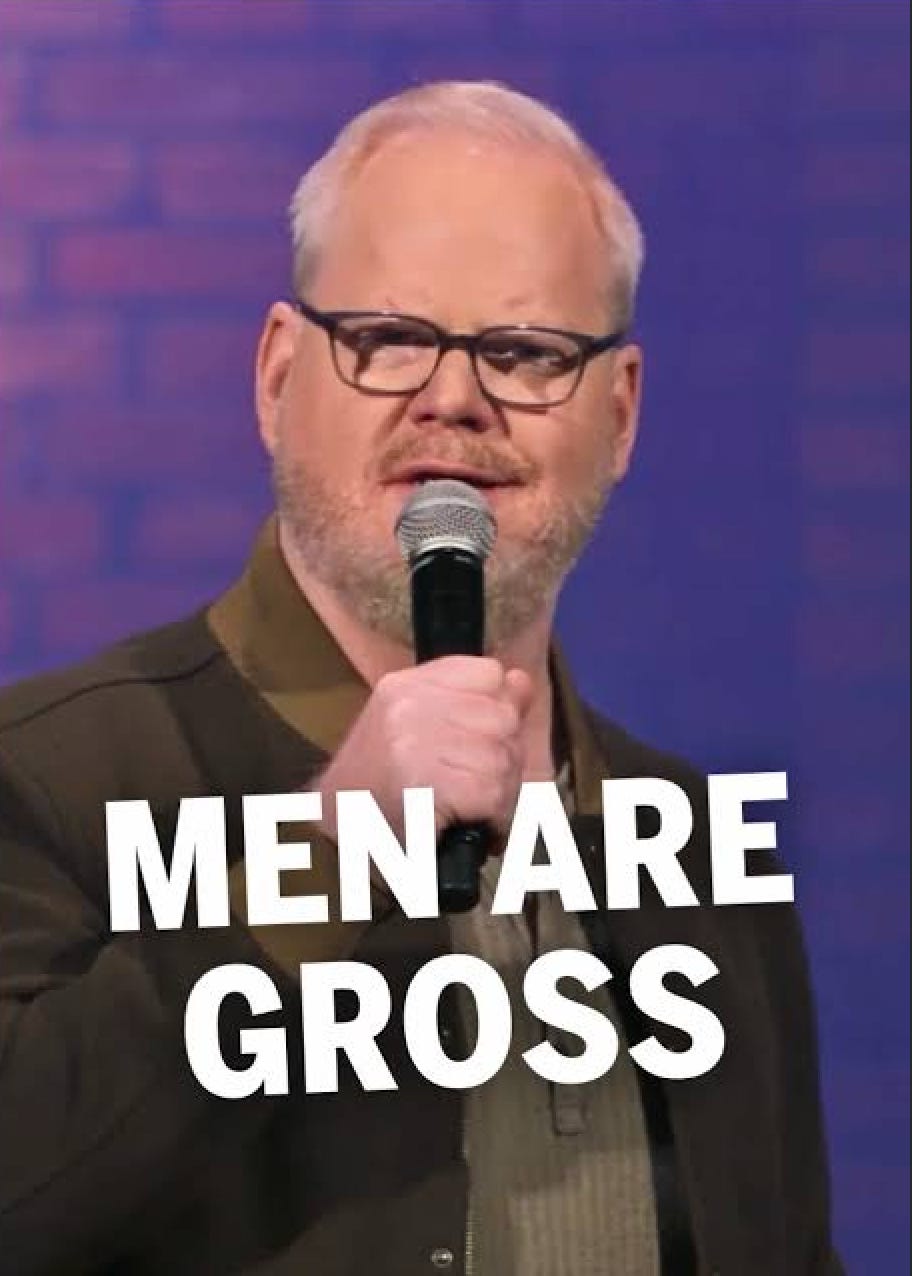
Again, I cannot emphasize enough, I understand why someone would feel the way that the individual behind this reel would feel. I do not deny the gravity of what they may have gone through in their past that has resulted in how they express their grief today, but this person also is a public figure, with a platform, who cannot deny that the purpose of creating such a reel is for the purpose of engagement and reaction. If one is in such a position, there is no exemption from a critique toward the above statement. De-centering men should not mean blockading any discourse from someone who is a man—especially a gay man. There was no disclaimer on this reel that it was only for a certain audience, and in the caption they state that people are free to “bean soup” about it, but once there is a voice that isn’t preaching to this choir, those individuals are shut down. If what one presents themselves as being only for the “he gays, the ‘theys’ and the girls,” then what “gays” are they actually referring to? Is it gay men? Because gay men are indeed still men, but it somehow feels as if they are othered here. In this monolith of MAN (have you seen them and met them?) where do gay men fit in? Or they in fact honorary women? Are they their own monolith that are expected to have their own cultural literacy and obligation of being a safe haven that heterosexual men? Perhaps their humanity is being flattened here as well. Surely we are not merely accessories that flank women and thereby denounce our manhood in the process. Gay men have had to question their manhood in a society that has constantly treated them as other, this has resulted in shame, guilt, and yes—internalized homophobia—but here, there seems to be this implied expectation that surely a gay man is NOT like other men, you know, those heterosexual men with their toxic masculinity. They are different.
However, this is essentialism at its worst. We are complex, we have our own traumas, our own discomfort with socializing among our straight counterparts, and so forth. But we are still men. Have you met us? Have you SEEN us? Why would there be this presumption that we wouldn’t take offense? Because we are non-threatening? Then again, most men who go about their lives, no matter what their sexuality, are generally non-threatening. Yes, there are too many who are, and the enormity of this problem cannot be denied. But imagine this: imagine if a gay man made a reel where he expressed his grief for heterosexual women entering his spaces and touching him inappropriately? This happens, and happens a lot. It has happened to me. In fact, I have my own past trauma pertaining to this. Then imagine this: what if he said this about those women who enter these gay or queer spaces:
“Have you MET women? Have you SEEN them? Why would I do that? Why would anyone do that?”
Now I really don’t think this is punching up versus punching down. That’s my opinion. Because the bottom line is that neither of these approaches consider the humanity of either sex. If the subject of this reel were to hear the above on the fictional gay man’s reel, I imagine they wouldn’t be too keen on hearing it, right?
This fictional gay man could say, “this is my lived experience” and feel absolved from any accountability from saying something so uncouth. The main point here is that we need to stop this. We really do. Men are no more a monolith than women, and highlighting the oppressor/oppressed dynamic also shirks a certain accountability as well, as it is not so binary, not so black and white, as that, as much as we want to believe it to be so. It is possible to make a point without reducing others to the most problematic characteristics that can be associated with one’s sex. Misandry as a response to misogyny will not be a solution to anything. As a lifelong, dyed-in-wool progressive for much of my life, I used to think that misandry didn’t exist, given the power dynamic between males and females. In recent years, I’ve actually reconsidered that. I never thought I would, but today, there are incels, there are fem-cels, there are those who not only want to de-center men, but also ridicule them, disempower them, and deny they have any value in society at all. I will not open that can of worms here, and I am sure some readers will give me much flack for even suggesting any of this, but I do see some over-correcting here that does not bode well for not only young males coming into their own, but also for the very coalition-building we need to fight the much larger, looming threats from those in power who do want to see this discord and division. “Divide and conquer.” We should not be afraid to have these difficult conversations to avoid feeling uncomfortable. We should not have to be accused of being “right-coded” or have political leanings scrutinized if we choose to challenge our own beliefs and the beliefs of others. Civil discourse is not right- or left-coded, it should be a universal principle.
One comment on that reel was well worth sharing here:
“Is making ‘men’ the category you define yourself against really more empowering than simply making yourself the center of your own life?”
And regarding the person who made this reel: I only chose this outlet because there wasn’t an openness for discussion. It was made clear that there was no obligation on the part of them to take any accountability and no need to apologize. Touché. We are adults. I can accept that. What is wonderful about our freedom to express ourselves is that I am open to share my rebuttal.
Be that as it may, I am so open to dialogue here, as always. I am always willing to reconsider my viewpoint and hear others out. And a healthy, constructive debate is something we need more of nowadays. If you agree with me, that’s great too, but I will always value different perspectives and gaining insight from other thoughtful minds.
Labeling people simply does not work, yet that is what humans are so inclined to do. I learned it well while parenting my own kids. Calling them “lazy,” “mean,” or other labels doesn’t help - it can become a belief they carry about themselves for years. Instead, the focus should be on understanding the specific behavior, not defining the person by it, and helping them learn how to navigate it. Same logic applies to what you are saying in this post.
We are a product of a lot of things, most of us with past trauma. We know so much more about trauma today than humanity ever has. I think it would do more good to find resources to heal rather than project your pain onto others (which will happen whether you want it or not).
I also do not believe rejecting the whole person because of their beliefs is helpful to anyone. This is exactly how this polarizing culture gets fueled.
P.S. I had to look up “incel culture” - so behind on the times. Yikes!
Still working out thoughts from this. I agree painting groups of people with such broad brush strokes isn’t all that helpful, but we all do it to a certain degree. For some, it’s like a shorthand to mean the most extreme versions in a given group. Admittedly, “influencer” (to me) has become a shorthand for the worst of the bunch. That’s on me, but I’m way more careful about not essentializing others (gender, ethnicity, etc.) than this person is. The algorithm rewards it though.